
Sore, Swollen Breasts in Early Pregnancy? Here's Why


Breast changes in early pregnancy may be one of the first symptoms you notice. So what do your breasts look like in early pregnancy?
Like our boobs, early pregnancy symptoms come in all shapes and sizes.
A missed period? Check. Fatigue that no amount of coffee can touch? Check. Breast changes in early pregnancy? Um, check.
So what breast changes in early pregnancy can you expect? And what do they feel like?
In this article: 📝
•
What do breasts look like early pregnancy?
•
How do nipples look in early pregnancy?
•
How do your breasts feel when you first become pregnant?
•
How soon do you notice breast changes in pregnancy?
•
How soon do your breasts swell when pregnant?
•
How did your breasts look and feel in early pregnancy?
What do breasts look like early pregnancy?
So how do your breasts look in early pregnancy? The truth is, the world of breasts is a diverse one ‒ and there’s no one way for them to look and feel.
That being said, there’s no denying that they go through some big changes during your pregnancy as your body prepares for mamahood. Throughout your pregnancy, your breasts may get bigger as they get ready to produce milk for your baby.
In this study, for example, breast volume increased by about 3.2oz from the start to the end of pregnancy. You might also notice some darker veins, bumps around your areola, and darker, harder nipples.

What does the areola look like in early pregnancy?
First off, the areola is the area around your nipple ‒ the circular patch that’s roughly the same color as your lips. Early pregnancy areola can look darker than usual, so you might notice that your normal areola vs pregnant is more pigmented.
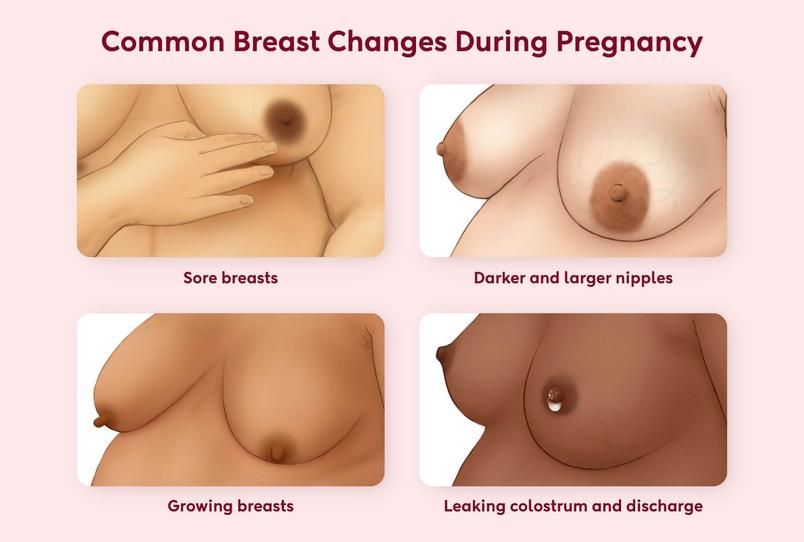
Some people notice these areola breast changes during pregnancy happen a bit later on than early pregnancy ‒ some during the second or third trimester. So you know a bit more about what to expect in the first trimester, here’s a snapshot of some areola breast changes in early pregnancy pictures (even as early as one week pregnant!) ‒ although your breasts may look different (our bodies come in all shapes and sizes), this is to give you an idea of what your areola will look like when pregnant:
How soon do areolas grow during pregnancy?
It’s true that your areolas are also likely to grow during pregnancy, for a larger surface area so baby can get their latch on when breastfeeding. But you probably won’t see your areolas growing until about the second or third trimester.
At what stage of pregnancy does the areola darken?
You will probably notice that your early pregnancy nipples get bigger and darker. The same goes for your areolas ‒ that’s the darker-colored skin around your nipples.
They also may look a bit more textured than before, with tiny bumps appearing on your areola. These bumps are called Montgomery Glands, and their primary job is to produce an oily substance that helps to keep the area clean and lubricated.
So if you think the white spots on nipples are a sign of pregnancy, you might be right!
How do nipples look in early pregnancy?
So what do your nipples look like in early pregnancy? Early pregnancy nipples vs normal nipples can look pretty different (they also might not ‒ every pregnancy journey is unique!). Just as your areola can darken, dark nipples might also be a symptom of pregnancy.
Just how dark do your nipples get when pregnant? Well, it depends ‒ nipples can look darker or lighter on different skin tones.
They can range anywhere from a dusky dark pink to a dark brown, and this change could happen anytime from even as early as one or two weeks pregnant ‒ they could be one of your first pregnancy symptoms before you get your BFP!
How do your nipples feel in early pregnancy?
Another change you might notice? You might just be feeling a little more turned on than before.
Let’s be real. Those nipples are feeling sensitive. Unless you have been advised otherwise by your doctor, having sex while you are pregnant is safe. And can be amazing.
And if you’re not into it, that’s also fine. Particularly if you’re feeling very uncomfortable and sore, it could be the last thing on your mind. Do what feels right for you.
You may also have sore nipples in early pregnancy ‒ again, this is totally normal, and can be due to the sensitivity of your nipples. Itchy nipples can also be a sign of pregnancy, again, due, in part, to being extra-sensitive. Hard nipples may also be a sign of early pregnancy, so if your nipples are feeling constantly hard with no (ahem) external stimulation, that could be the reason why.
How do your breasts feel when you first become pregnant?
With your growing breasts in early pregnancy, you can usually expect a little pain or discomfort. You might notice a feeling similar to tender breasts before your period.
Some of our Peanut moms-to-be also tell us they’ve felt a tingling sensation ‒ sort of like pins and needles ‒ across their breasts as they change in early pregnancy, and throughout their pregnancy journey.
What kind of breast pain indicates pregnancy?
It’s hard to say ‒ every pregnancy journey is different, as every body is different. But many of our Peanut moms-to-be say the breast pain that they felt during early pregnancy was similar (if not the same) as the tenderness they felt as part of their PMS (pre-menstrual syndrome) symptoms.
Others say they didn’t feel much breast pain during early pregnancy, instead more of a tingling, fuzzy sensation.
What part of the breast hurts in early pregnancy?
Anywhere, really. For some people, all over. For others, just the nipples can be painful during early pregnancy. And for others still, their areola might feel itchy.
After all, we’re all different, and no two boobs are alike! But for many of our Peanut moms-to-be, the first place to feel extra-sensitive is the nipples.
How soon do you notice breast changes in pregnancy?
So how soon can you expect construction to kick into gear on this project? As it turns out, very early on.
You may notice changes to your breasts as early as week 1 of your pregnancy. Yep, that means that these changes can be one of the first signs that you’re pregnant.
In these early days, your breasts may feel a little tender, tingly, or achy.
So what’s going on here? What are they trying to tell you?
Basically, they’re transforming themselves into milk-producing machines, and they want to get a head start on the job. To understand this, let’s head back to your younger days. Your milk duct system has been with you since puberty. With each of your periods, thanks to the estrogen your body produces, that system grows and matures. Progesterone joins the party to help you develop milk glands called lobules. These processes are part of your body’s monthly preparation for pregnancy.
Yep, that’s why PMS can be accompanied by that tender breast feeling ‒ and sometimes some additional lumps and bumps. When you become pregnant, your breast tissue increases as the milk-producing system matures and grows rapidly. Ducts grow (thanks to estrogen) and many more lobules are formed (thanks to progesterone).
Added to this, there will be an increase in blood flow. By the time you hit month six, your breasts are capable of producing milk. (And yes, leaks happen.)
So what does this all look and feel like for the owner of the boobs? Here’s some of what you might expect for breast changes in early pregnancy:
- With all these changes afoot, your breasts might feel more tender, achy, and tingling.
- They may also feel swollen as that increase in tissue causes some overcrowding.
- Blood vessels in your breasts may look more pronounced as blood flow increases to this area.
- You may have to go bra shopping as your breasts increase in size. But don’t worry if this is not the case. Some breasts don’t grow much at all ‒ and that’s totally fine.
How soon do your breasts swell when pregnant?
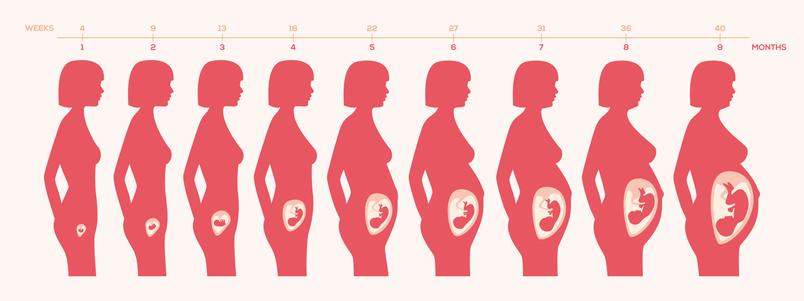
For some pregnant people, their breasts get bigger within days of being pregnant. For others, it can take up to about week 13, at the end of the first trimester.
As your breasts get bigger, it’s important to make sure you have the right support with a maternity bra, to avoid discomfort and back pain.
How did your breasts look and feel in early pregnancy?
So you know you’re not alone, however, your breasts are feeling and looking right now, we asked our Peanut community to share their breast changes in early pregnancy:
- “Pretty much the only symptom I have in my two-week wait is slightly sore boobs.” ‒ Kami
- “With my first pregnancy my early symptoms before a positive was actually loose stools, cramps, tender boobs, headaches, bloating and nausea here and there.” ‒ Aamina
- “My symptoms before my positive were slowed digestion from progesterone but not to the point of constipation, sore breasts, fatigue, and very obvious uterine cramps/stretching (that could have been more sensitive due to IVF).” ‒ Angela
- “My nipples got super sensitive and irritated.” ‒ Kaitlyn
- "My boobs felt super big and firmer than usual really early, like the day after I got my positive test." ‒ Tassia
- “My breasts have been veiny and bumpy around my areolas for the past 2-3 weeks now.” ‒ Mya
- “My boobs didn’t change appearance in the early beginning they were just sore AF.” ‒ Kristyn
- “My breasts look get veiny and bumpy around the nipples sometimes throughout pregnancy… it comes and goes and my nipples usually are erect.” ‒ Nelly
- “Currently 12 weeks pregnant, my nipples are huge!” ‒ Michelle
- “My breast veins have been super visible since about 6 weeks its totally normal as are the white spots. And they itch, they are huge, I've even got milk in at 11 weeks.” ‒ Caitlin
- “My veins did pop out more as in they looked way more blue and noticeable, my areolas got bigger and my nipples got darker in general.” ‒ Elsa
- “Pregnancy hurt a lot more for me than PMS. I felt my breasts get heavy and my nipples have never been sore or sensitive and they definitely are pregnant.” ‒ Alyssa
- “I never had morning sickness at all, but my breasts were super super super sore to start (first 6-7 weeks) and then never bothered me again.” ‒ Mary
- “I’m just over 5 weeks pregnant, I know that sore breasts are common at this stage. But last night I woke up and I felt like my breasts were going to explode through my skin! My fiancée had to bring me ice to ice them!” ‒ Katie
- “The first 7 weeks, my boobs were angry. They've settled now, just huge from a 30DD to a 30F!” ‒ Lou
- “My early pregnancy boobs were so so sore for weeks and weeks I couldn’t sleep on my front for a while. It’s how I knew I had to take a test because they just were so sore! Non-wired bras saved me!” ‒ Dani
- “I didn’t have breast tenderness at like 4 weeks and now I’m over 6 weeks and it’s so bad!” ‒ Tasha
- “Feeling a lot of pain in my boobs today and funny sensations in my belly too, had the early scan I know everything is fine just curious if anyone else had this at 7 weeks feel like boobs just got even bigger and more swollen today.” ‒ Teresa
- “My breasts have been painful and getting bigger already the past 6 weeks and I’m only 8 weeks in! Struggling with the discomfort!” ‒ Hanna While it’s normal to experience breast changes in early pregnancy (or at any point in your pregnancy), if you experience any symptoms that seem out of the ordinary, check in with your doctor.
Some things to watch out for? Bloody discharge from your nipples. This could be a sign that your ducts are clogged.
And if you notice any abnormal lumps in your breast, whether you are pregnant or not, it’s important to talk to your healthcare provider. In rare cases, lumps can be a sign of pregnancy-associated breast cancer. Early diagnosis here is key.
There’s no one way for your breasts to look and feel. Your body is going through some pretty incredible changes right now. Full permission to do this your way, at your pace, in your body.
And if you want to talk to anyone who gets it, you’re welcome to join us on Peanut.


Popular on the blog

Mom Feet: Why Pregnancy Changes Your Feet (and What You Can Do About It)
By
Tassia O'Callaghan

Pregnancy Rage: Is It a Thing? Why Does it Happen?
By
Katie Mill

Tailbone Pain During Pregnancy: Why Does It Happen?
By
Katie Mill

Pregnancy Nose: What Is It & Why Does It Happen?
By
Katie Mill

Pregnancy Food Aversions: Causes, Symptoms & Solutions
By
Tassia O'Callaghan

Pregnancy Glow: Is It a Real Thing?
By
Katie Mill
Trending in the community
My baby boy
Hello everyone we are new here and wanted to share my baby this is Matthew boy he is soon to be one on oct 6 so excited ☺️

3
7
Should I be worried my obgyn is acting sketchy?
I went for my anatomy scan she said baby girl is perfect. But then referred me for a 2nd anatomy scan to check for placental problems. I asked was there signs of any issues and she said it’s just a precaution. But many of my mom friends say they haven’t had to get a 2nd opinion and feel she should have be more straight forward.

10
Pregnancy after C-section
I’m 5.5 weeks pregnant. I had a C section with my last baby almost 4 years ago. Did anyone else experience more cramps with activity in their pregnancies after having had a C-section? I’m thinking it might be due to scar tissue? I’m really worried bc the pain is pretty intense. Any and all feedback is welcome! The doctor is no help

5
Hip cramps & pain at night - 23weeks (have had it for ages)
Although it might be a normal symptom for pregnancy, I haven’t slept properly in what feels like months now. I eat a banana a day, drink as much water I can, and use magnesium body butter at night. Can anyone recommend something that worked for them? I have been looking at Oshun magnesium and/or electrolytes that I can add to water but remember my midwife telling me not to take electrolytes/extra. Any advice welcome, I just wanted to sleep without the constant “left, right, left, right…” Sometimes up at 3/4am and still working full-time teaching maths so really struggling. 🙏🏼

9
32 weeks - ways to start preparing and softening cervix for natural labour?
I’d like to try for a VBAC , I didn’t dilate with my last so any tips on how to prepare my body please 🙏🏻 I really don’t like raspberry leaf tea!
3
Sending lots of love to all you September mums who are still waiting!
❤️❤️

15
4
Find your
village

Scan to Join
Rated 4.4


Trusted by 6M+ women
.png?_wwcv=1842)
Download the Peanut App


