
Can Pregnant Women Eat Salmon?


Can pregnant women eat salmon?
Absolutely!
Thanks to its high protein content, omega-3 fatty acids, and vitamins like zinc, iron, and vitamin D, it’s even positively recommended.
That said, there are some things to be aware of when eating salmon when pregnant.
Here’s what you need to know.
In this article 📝
•
Why is salmon “not good” for pregnancy?
•
So, can pregnant women eat salmon, or not?
•
Can I eat cooked salmon while pregnant?
•
Which fish should be avoided during pregnancy?
Why is salmon “not good” for pregnancy?
Let’s start with some of the more serious stuff.
There are a couple of common concerns around mamas-to-be and salmon.
The risks are really small, but it’s important to have all the information you need to make an informed choice:
- Mercury. When people say "seafood and pregnancy", most people immediately think of mercury. This chemical element is absorbed from the water and collects in fishes’ fat stores. It can be dangerous, because even small amounts can damage a baby’s developing brain. Luckily, though, the levels in salmon are pretty low.
- Pollutants. Oily fish often take in pollutants from the water. The biggest concern is a group of chemicals called polychlorinated biphenyls (PCBs for short). Again, not something you’d want to end up in your baby’s body. That’s why health organizations suggest limiting salmon to about 140 grams a week.
- Parasites. The last of the nasty things potentially lurking in fish, parasites can be difficult to treat and can damage your baby’s brain and eyes. Make sure the salmon is cooked through properly, and you’ll be fine though.


So, can pregnant women eat salmon, or not?
Absolutely you can, but it’s best to do it with a bit of extra care.
In reality, salmon usually contains much less mercury and PCBs than other large or oily fishes, and farmed salmon are usually treated with antibiotics and anti-parasitics to reduce the risk of worms.
That doesn’t mean they are totally risk-free, but contamination is extremely low.
What’s more, the benefits of salmon outweigh the risks for many mamas-to-be.
It contains omega 3, DHA (a fatty acid essential for your baby’s brain development), and is packed with protein, and vitamins.
It’s good for your heart, your blood pressure, and your immune system.
To keep things extra safe, it’s best to follow some simple steps:
- Limit salmon to two portions a week. That’s about 8oz or 140 grams in total. This’ll keep pollutants to a minimum.
- Make sure it’s super-fresh.
- Ensure it’s cooked through. This should kill any parasites or bacteria that are lurking on the fish.
Can I eat cooked salmon while pregnant?
Cooked salmon — fresh or canned — is the best type of salmon you can eat while pregnant.
But what about other types of salmon?
Can pregnant women eat smoked salmon?
Cold smoked salmon, AKA lox, is delicious as an appetizer or as a topping for your breakfast eggs.
Unfortunately, this is something that most women will want to steer clear of when they’re pregnant.
Smoking is a curing process rather than a cooking process.
That means that it doesn’t remove the risk of bacterial contamination in quite the same way.
Also, because you’re eating the fish without fully warming it a second time, any bacteria that it came into contact with after smoking stays on the fish.
So, again, this is best left avoided until your little one is safely delivered into the world.
Can pregnant women eat raw salmon?
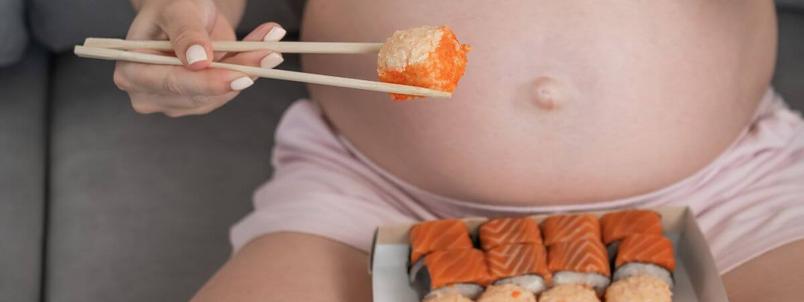
Sushi is usually fairly close to the top of people’s lists of foods to avoid during pregnancy and raw salmon is one of the most common culprits for this.
Freezing the salmon first should kill any parasites or bacteria on the fish.
But it’s not always guaranteed.
Holding out for your baby to arrive before tucking into those California rolls is definitely advice we can get behind.
Related: Can Pregnant Women Eat Sushi?
Can pregnant women eat pink salmon?
Really, it’s safer to make sure that salmon is completely flaky and cooked through before you eat it.
Even if most chefs would rather serve it slightly on the pink side, it should have an internal temperature of at least 145°F.
If you don’t have a thermometer at home, look for the fish to be steaming, flaking apart, and completely opaque.
Can pregnant women eat canned salmon?
Yep, canned salmon is safe to eat during pregnancy because it’s pasteurized during the canning process and sealed in a sterile environment.
If you’re watching your portion size, measure the drained weight rather than the total weight of the can.
Which fish should be avoided during pregnancy?
A note before we go.
Although cooked salmon is a great thing to eat during pregnancy, there are some fish that you should steer clear of.
These are generally larger fish that live longer, swim in deep water, and end up absorbing more pollutants and mercury than salmon do.
The ones to be wary of (according to the FDA) are:
- Swordfish
- Shark
- King mackerel
- Marlin
- Orange roughy
- Bigeye tuna
- Tilefish from the Gulf of Mexico
And if you’re on the hunt for completely pregnancy-safe meal ideas, look no further than Peanut.
Here are some scrummy foods to eat while pregnant.
More on pregnancy foods: Can You Eat Oysters While Pregnant? Can Pregnant Women Eat Shrimp? Can Pregnant Women Eat Crab? Can Pregnant Women Eat Lobster? Can Pregnant Women Eat Tuna? Can Pregnant Women Eat Sushi? Can Pregnant Women Eat Crawfish? Can Pregnant Women Eat Ceviche? Can Pregnant Women Eat Calamari? Can Pregnant Women Eat Mussels? Can Pregnant Women Eat Scallops? Can You Eat Seaweed While Pregnant?


Want to find your village?

Scan to Join
Rated 4.4


Trusted by 5M+ women
.png?_wwcv=1371)
Download the Peanut App


