
Tilted Uterus 101: Causes, Symptoms & Pregnancy


If you're planning a family (or have one already!), your uterus is an organ that does a lot throughout your life.
From menstruation to conception, all through housing your growing baby for about 9 months.
But what does it mean if you've been told you have a retroverted (or tilted) uterus?
Well, you're among the 25% of the world's population, if that's the case!
Is it rare? Will it affect pregnancy? Does it affect your periods?
Well, that's where it deserves a little more explanation than a simple yes or no.
So let's find out more.
In this article: 📝•
What does a tilted uterus look like?
•
Is a retroverted uterus good or bad?
•
Is a retroverted uterus more likely to prolapse?
•
What are retroverted uterus symptoms?
•
What causes a tilted uterus?
•
Can a retroverted uterus get pregnant?
•
Should a retroverted uterus be fixed?


What does a tilted uterus look like?
Let's start with a quick lesson on uteruses (or uteri, if you prefer).
Imagine your uterus as the shape ‘U’.
Ideally, it tilts forward towards the abdomen, called an anteverted uterus.
In a retroverted uterus, it's tilted back, towards the rectum.
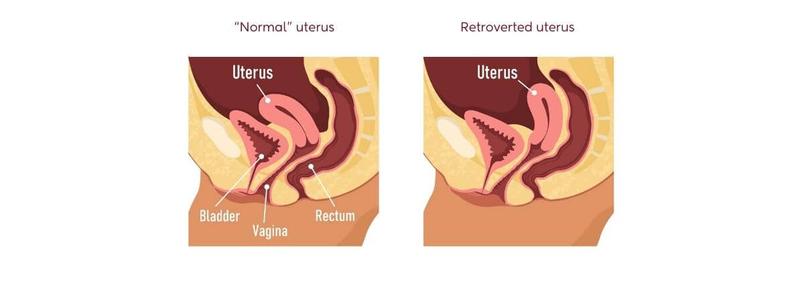
What happens if the uterus is retroverted?
Well, with a retroverted uterus, the opening is towards the cervix, and the curved part points at the lower back.
Now, is it a cause for panic? Not really, no.
In fact, having a retroverted uterus isn't as rare as you might think — around 25% of the global population has it, and you would only know if you have it or not, via a pelvic exam.
And if you do, it's a totally normal variation of how the uterus can develop.
Is a retroverted uterus good or bad?
Well... neither.
Having a tilted uterus is nothing out of the ordinary — it’s just another way your uterus could exist within your body.
You can either be born with a retroverted uterus or even develop it later on in life.
For most people who have periods, it often doesn't cause any major health issues.
Is a retroverted uterus a birth defect?
No, a retroverted uterus is not a birth defect.
It can be genetically passed on, yes, but it's not a defect as it does not affect fertility or overall reproductive health.
So even if you have it, and your future kids end up having it, they might experience mild to moderate symptoms at the most, but nothing that would classify it as a birth defect.


Is a retroverted uterus more likely to prolapse?
Technically, yes, a retroverted uterus can be a risk factor for prolapse.
A prolapse is a condition that involves the uterus slipping down into the vaginal canal and is more likely to happen after menopause.
This can happen if the muscles that hold your uterus in place get weakened or damaged (like menopause, childbirth, or uterine trauma).
This study suggests that prolapse is 4.5 times higher in a retroverted uterus compared to an anteverted one.
Another study even went so far as to class having a retroverted uterus as a “risk factor” for prolapse.
But ultimately, even though having a tilted uterus can mean prolapse is more likely to happen, there are other factors, too.
What are retroverted uterus symptoms?
You could have a tilted uterus, and not experience any symptoms.
But on the other hand, here are some known mild to moderate symptoms of a tilted uterus:
- Pain during your period
- Pain during certain positions during sex
- Urinary incontinence or frequent UTIs
- Trouble inserting a tampon or menstrual cup
Can you use tampons with a tilted uterus?
Yes, people who menstruate and have a tilted uterus can use tampons.
The position of the tilted uterus holds no restriction.
But the only hiccup with this could be when you're inserting the tampon — a retroverted uterus can make it slightly harder to insert a tampon.
If this is the case, either different positions or products, like pads, menstrual cups, or menstrual disks could be options.
Can retroverted uterus cause painful bowel movements?
In some cases, yes — and the science backs it up.
This is because the position of the tilted uterus tends to exert pressure on the rectum (the final section of the large intestine) and in turn, cause discomfort during bowel movements.
Does retroverted uterus cause endometriosis?
Not directly, no — there are no studies that directly correlate a retroverted uterus with endometriosis.
Endometriosis is a condition where the inner lining (or a similar tissue) of the uterus grows outside and spreads to organs such as the fallopian tubes and the ovaries.
But here’s what’s interesting: it's actually the other way around.
Endometriosis has been known to cause a tilted uterus that develops later in life.
This is because in endometriosis if the growing tissue or lesions spread outside the uterus, it may attach to other organs.
This can cause the uterus to stick in a backward position, almost gluing it in place, in a tilted position.
Interesting, right?
Does a retroverted uterus cause back pain?
If you’ve been feeling that extra back pain during your period or otherwise, your tilted uterus may be the culprit.
It's because, with a tilted uterus, it points toward your lower back, as this study suggests.
But it might not be the only reason for your back pain, so it's worth getting it checked out.
Can a retroverted uterus cause urine retention?
Maybe — around 3 in 220 women might experience urine retention with a retroverted uterus, as per this study.
It's not exactly a high number, so it's tough to say definitively whether they're linked.
But if you’re someone who has experienced urine retention with a tilted uterus in your first pregnancy, it's best to have a chat with your healthcare provider.
They can help with treatment and how to potentially ward it off if you want to get pregnant again.
Does a tilted uterus affect periods?
Painful cramps? Especially at the lower back?
If that sounds like an “almost every cycle” thing, your tilted uterus may be the culprit.
As it's tilted back towards the spine, those lower back cramps can pop up during menstrual cycles.
That being said, a tilted uterus shouldn't affect the regularity of your menstrual cycle or cause abnormal periods.
If you notice either of those, it's worth checking in with your doc.

What causes a tilted uterus?
Well, there are a few potential causes of a tilted uterus:
- Genetics — having a retroverted uterus could be hereditary.
- Scarring or adhesions from pelvic surgery. These adhesions can cause the tissues of your uterus to stick to other organs, pulling it back or tilting it.
- Fibroids and endometriosis — uterine growths that can cause a similar effect as the adhesions above.
- Childbirth — after birth, your pelvic floor muscles and ligaments are stretched, which can cause your uterus to tilt backward.
- Menopause — during menopause, there’s a lack of estrogen, which can cause weakened pelvic muscles. The ligaments (connecting tissues) that hold the uterus may not be as strong anymore, leading to it tilting backward.
Is a tilted uterus genetic?
Genetics may be one of the causes of a tilted uterus.
Some people are born with a tilted uterus, so there's a higher likelihood of genetics playing a part in such cases.
Can a retroverted uterus get pregnant?
Yes — having a retroverted uterus shouldn't affect your ability to conceive.
It doesn’t impact the sperm’s journey until the egg, either.
So you can get pregnant normally, even with a tilted uterus.
It is also possible that your retroverted uterus may even become anteverted during the second trimester as baby grows.
But it will revert back to its retroverted position once you have your baby.
Can a tilted uterus hide pregnancy?
No, having a retroverted uterus does not hide your pregnancy.
Sometimes, it can just make your baby bump appear a little later, like in the second trimester.
People with an anteverted uterus show earlier than the second trimester.
But did you know that having a retroverted uterus can also make it slightly difficult to identify the baby during ultrasounds?
This is because a tilted uterus means a baby that's further away from the ultrasound probe, leading to unclear images, so a transvaginal ultrasound may be able to give you a clearer picture of baby.
How to get pregnant fast with a retroverted uterus?
A tilted uterus doesn’t really affect your fertility.
But you might find that certain sex positions cause some pain or discomfort, due to your uterus' tilted position.
To avoid this, have an open conversation with your partner, to narrow down on positions that are comfortable for you, and can increase control and depth of penetration.
This can help boost your chances of conception.
Should a retroverted uterus be fixed?
In most cases, no, a retroverted uterus doesn't require treatment.
But if you do experience moderate to severe symptoms, associated conditions such as endometriosis, or fertility issues, medical intervention may be considered.
So it's worth talking to your doctor if you're worried about it.
How to fix a tilted uterus?
Treatment for a tilted uterus is generally not needed.
But, if you have severe symptoms, you can potentially have a keyhole surgery to reposition the uterus over the bladder — it's a simple, straightforward laparoscopic surgery procedure.
Most people rest and recover on the same day, but you can also choose to extend your recovery to the next day.


Whether your uterus is tilted, upside down, or doing the limbo, understanding your body is always a good thing.
And if you're trying to conceive with a tilted uterus or just want some support on your journey, hop on over to Peanut — because you're not alone in this.
We’re here for you. ❤️


Want to find your village?

Scan to Join
Rated 4.4


Trusted by 5M+ women
.png?_wwcv=1371)
Download the Peanut App


